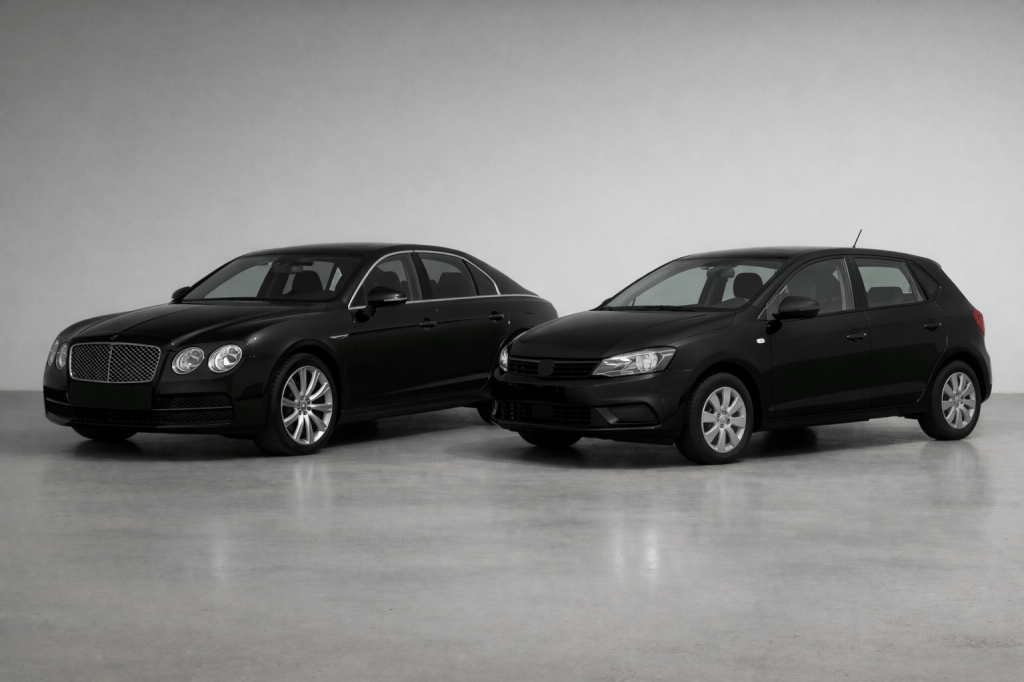
An entirely speculative but increasingly obvious imbalance in modern car making, illustrated by the concepts flooding your screen.
Introduction
This is not about a single car, because there isn’t one.
There is no official press release, no embargoed test drive, and no whispered prototype hidden under a dust sheet in Munich or Stuttgart. What you are seeing online instead is a pattern: concept images, renders, and “what if” vehicles that expose something rather uncomfortable.
Cheap brands are improving at an alarming rate.
Luxury brands, meanwhile, appear to be coasting.
The absurdity is not that budget manufacturers are getting good. It’s that they’re now doing the thinking, while premium brands are doing the bare minimum and charging extra for the privilege.
Brand DNA vs the New Reality
Luxury car brands love talking about “DNA”.
It’s their favourite word, usually deployed when they can’t quite explain why a £90,000 SUV has the same switchgear as a £32,000 hatchback.
The trouble is that brand DNA only matters if it’s actively maintained.
What we’re seeing now is budget manufacturers aggressively evolving their identity, while luxury brands are relying on heritage as if it were a subscription service. Pay monthly, receive prestige, no further effort required.
Look at recent concept imagery circulating online — the small, sharp, improbably premium city cars wearing badges from brands that used to specialise in cheap transport. These designs aren’t just competent. They’re confident. Proportions are right. Surfacing is deliberate. Lighting signatures look intentional rather than decorative.
Now compare that to the latest output from some luxury marques. Taller, heavier, less elegant. Bigger grilles because nobody knew what else to do. Screens glued on like afterthoughts. Interiors that feel cost-engineered rather than crafted.
One side is hungry.
The other is comfortable.
That difference shows.
Design Implications: When Effort Becomes Visible
Design tells the truth faster than marketing ever could.
Budget brands now design cars as if they expect to be judged harshly — because they do. Every crease, every graphic, every surface has to justify itself. There’s no assumption of forgiveness.
Luxury brands, on the other hand, increasingly design as if the badge itself will do the heavy lifting. And it shows.
You see it in proportions that are slightly off, but hidden under size.
You see it in lighting signatures that exist only to look expensive at night.
You see it in unnecessary complexity where simplicity would have looked confident.
Some recent luxury concepts look impressive in isolation but hollow up close. They rely on theatre rather than coherence. Meanwhile, “cheap” brands are quietly mastering restraint — the one thing luxury is supposed to own.
The irony is delicious. And slightly alarming.
Interior Philosophy: Who Still Cares?
Once upon a time, luxury interiors were where the gap was unbridgeable.
Soft-touch materials, intelligent layouts, mechanical tactility — things you couldn’t fake on a budget.
That advantage is disappearing.
Budget brands now prioritise usability. Logical controls. Clean layouts. Screens that do one job well instead of seven badly. Materials that may not be exotic, but are chosen carefully and assembled properly.
Luxury brands, by contrast, have fallen in love with digital excess. Everything is a screen. Everything is glossy. Everything fingerprints instantly. Physical controls are removed in the name of “modernity”, which is usually code for “cheaper to manufacture”.
This isn’t progress. It’s complacency.
When a £28,000 car feels calmer, clearer, and better thought-out than a £75,000 one, something has gone badly wrong in the boardroom.
Market Positioning: Who Is This Actually For?
Luxury brands still price as if they’re indispensable.
Budget brands price as if they’re trying to win.
That difference matters.
The modern buyer is better informed, less brand-loyal, and far more willing to walk away. They know what technology costs. They know which platforms are shared. They know when they’re being upsold nostalgia.
And crucially, they know when a cheaper car offers 90% of the experience for 60% of the money.
Luxury brands seem to be betting that aspiration alone will carry them indefinitely. That customers will keep paying more for less, simply because they always have.
History suggests this is a dangerous assumption.
Brand Risk: Prestige Is Not a Renewable Resource
Prestige erodes quietly.
It doesn’t collapse overnight. It fades. First through jokes. Then through indifference. Eventually through irrelevance.
When people start saying, “It’s nice, but it’s not what it used to be,” the damage is already done. When they start cross-shopping luxury badges with budget ones, the alarm should be deafening.
Yet many premium brands continue to behave as if their position is unassailable.
It isn’t.
Luxury is not defined by price. It’s defined by care. And care is becoming increasingly unevenly distributed across the industry.
Potential Specifications
To understand how this shift is happening, it’s useful to ground the discussion in what would be required to make these hypothetical “budget but brilliant” concepts viable.
Not predictions — requirements.
- Powertrain
Shared turbocharged petrol or hybrid systems already in mass production, prioritising refinement over outright output. - Power output
140–200 hp is sufficient when paired with low weight and intelligent gearing. - Drivetrain
Front-wheel drive or compact all-wheel drive using existing modular systems. - Platform
Group-wide modular architectures, already amortised and well understood. - Performance estimates
0–60 mph in under 8 seconds, with emphasis on smoothness rather than speed. - Estimated price range
£25,000–£35,000 — expensive for a cheap brand, disruptive for a luxury one.
None of this is exotic.
That’s the point.
Reality Check
Could this be built?
Yes. Most of it already exists.
Would it make financial sense?
For budget brands, absolutely. For luxury brands, only if they accept lower margins.
Is there a realistic customer for it?
Yes. Increasingly so.
Final Verdict
Cheap brands are not becoming luxury brands.
They’re becoming competent, confident, and dangerously close.
Luxury brands, meanwhile, are betting their future on badges, screens, and the assumption that nobody will notice the effort has dropped.
They will notice.
And when they do, the definition of “premium” will change — with or without permission.


 UNBUILT GARAGE
Leave a comment