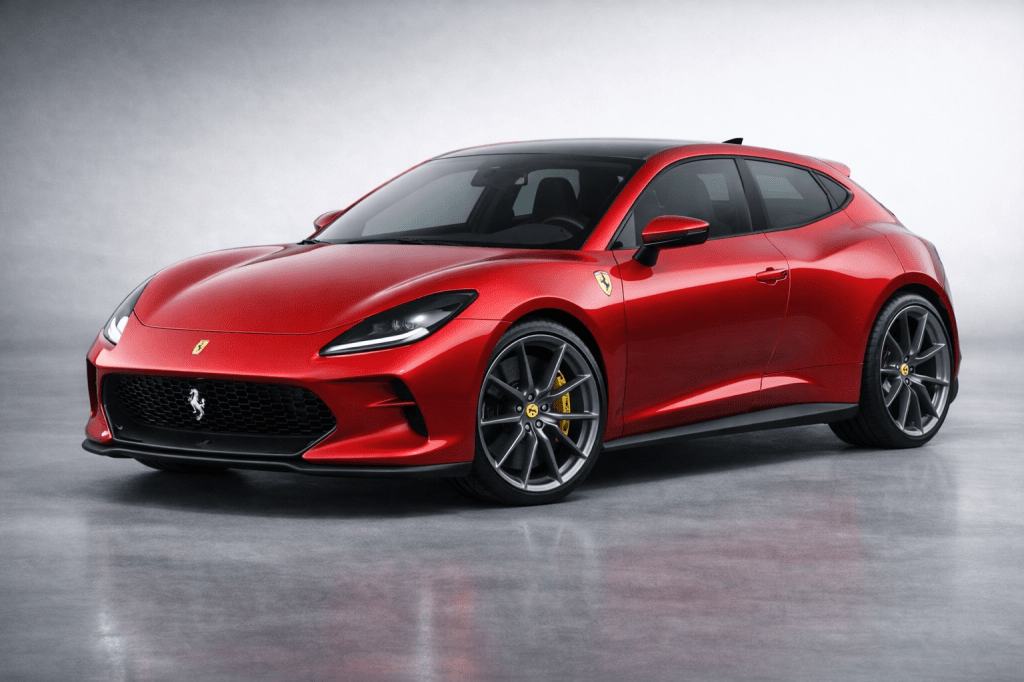
A speculative look at what happens when a supercar brand meets speed bumps, cyclists, and 20-mph limits.
Introduction
Let’s get this out of the way immediately: the Ferrari Urbanetta Concept does not exist. Ferrari has not announced it, designed it, or even hinted at it. And yet, the idea keeps appearing online in glossy renders and breathless captions, because the internet has decided Ferrari’s future problem isn’t batteries or emissions — it’s traffic.
Specifically, city traffic. The kind that involves bus lanes, delivery vans parked “just for a minute,” and junctions designed by people who clearly hate drivers. The absurdity is obvious: Ferrari, a company built on speed, theatre, and mechanical excess, trapped behind a recycling lorry doing nine miles an hour.
So the question becomes unavoidable. Not should Ferrari make a city-focused car — that’s a bad idea and we’ll get to why — but what does it say about the modern world that people think it might need to?
This is less about a car, and more about a contradiction on wheels.
Brand DNA vs the City Car Idea
Ferrari’s brand DNA is not subtle. It is loud, impatient, and fundamentally uninterested in compromise. Ferrari exists to turn fuel into noise, tyres into smoke, and money into something emotional.
A city car, by contrast, exists to do none of those things.
It is designed to be short, quiet, efficient, and apologetic. It fits into parking spaces that were clearly drawn with a ruler and a grudge. It prioritises visibility over drama, manoeuvrability over theatre, and low-speed compliance over anything resembling joy.
Now imagine explaining that to Ferrari.
Imagine telling Maranello that the future involves softer throttle maps so you don’t spill someone’s oat-milk latte at a zebra crossing. Imagine designing a Ferrari that is at its best at 17 mph, with regenerative braking optimised for stop-start misery.
This isn’t evolution. It’s a personality transplant.
Ferrari has survived by being deliberately impractical. The idea that it should now adapt to urban congestion misunderstands why Ferrari exists in the first place. It is not a solution to modern transport problems. It is an escape from them.
Ferrari’s Biggest Problem Isn’t Electric Cars — It’s City Traffic
This is the uncomfortable truth at the heart of the Ferrari Urbanetta Concept: electric drivetrains aren’t the real threat to Ferrari’s identity. Traffic is.
Electric power can still be fast. It can still be dramatic. It can still rearrange your internal organs if applied correctly. Ferrari can — and likely will — make electric cars that feel suitably feral.
But traffic? Traffic neuters everything equally.
A Ferrari in city traffic is reduced to a very expensive sculpture with indicators. Its engine note is irrelevant. Its aerodynamics are pointless. Its performance figures are theoretical, like a gym membership in January.
This is why the idea of a Ferrari city car keeps surfacing. Not because Ferrari needs one, but because its customers increasingly live in places where using a Ferrari properly is impossible.
The Urbanetta Concept isn’t about urban mobility. It’s about frustration.
Design Implications: Shrinking the Prancing Horse
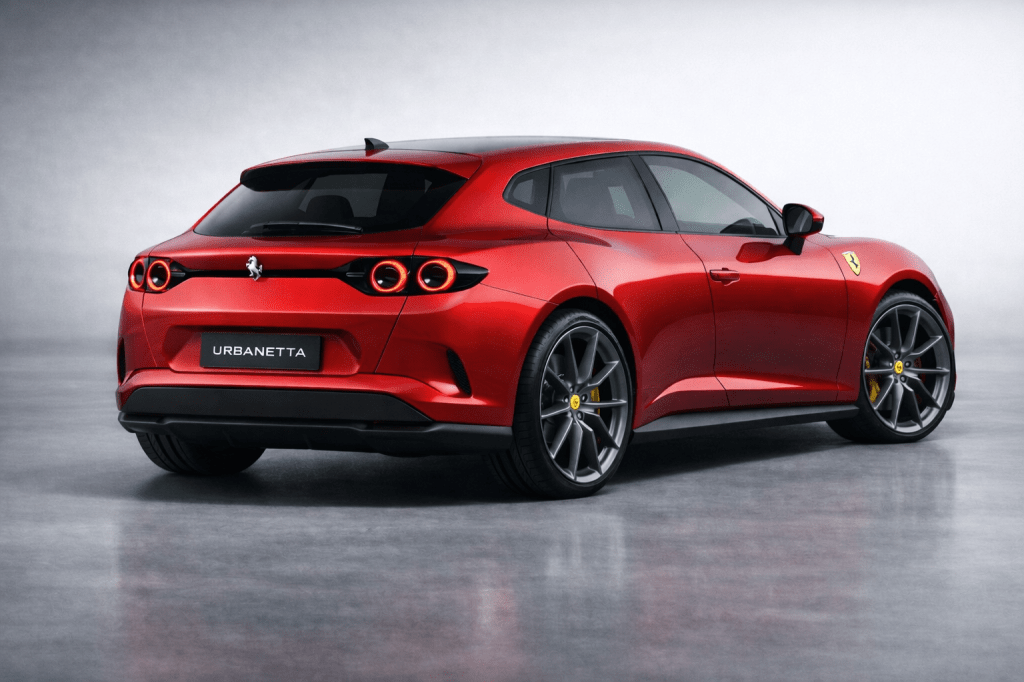
The concept images usually show something compact, upright, and faintly apologetic. Short overhangs. Big wheels. A face that tries very hard to look serious despite being no larger than a supermarket trolley.
And here’s the problem: Ferrari design relies on proportion. Long noses, wide hips, visual tension. Shrink it too much and it starts to look like cosplay.
You can add aggressive headlights, deep creases, and a shield badge the size of a dinner plate, but the fundamental issue remains. A small Ferrari looks like it’s been accidentally put in the wrong wash cycle.
Worse still, compact dimensions expose compromises. Thin tyres. Short wheelbases. Upright seating. All the things Ferrari traditionally avoids because they dilute the sense of occasion.
A Ferrari should look like it’s moving even when parked. A city car looks like it’s waiting for permission.
Interior Philosophy: Drama vs Daily Reality
Ferrari interiors are theatres. Carbon fibre. Exposed metal. Switchgear that feels like it belongs in something designed to break sound barriers.
A city car interior is an office. Storage cubbies. Cupholders. Places to put your phone, your coffee, your reusable bag, and your mild disappointment.
The Urbanetta Concept usually imagines a blend of both: racing-inspired seats, a compact steering wheel, digital displays everywhere. And inevitably, practicality creeping in like damp.
Because if you’re making a city Ferrari, someone will ask where the shopping goes. Someone will ask about rear seats. Someone will ask whether the suspension can survive potholes without shattering vertebrae.
And the moment Ferrari starts designing around those questions, something fundamental has gone wrong.
Ferrari interiors are meant to make you feel like you’re about to do something irresponsible. City cars are meant to make you feel organised.
Those emotions do not coexist.
Market Positioning: Who Is This For?
This is where the Urbanetta Concept truly falls apart.
Ferrari buyers do not want cheaper Ferraris. They want more Ferrari. More power, more noise, more theatre, more nonsense.
A city-focused Ferrari would inevitably be pitched as an entry-level model. Smaller. Less powerful. More “accessible.” And that word should immediately trigger alarm bells.
Accessibility has never been Ferrari’s problem.
The people who can afford Ferraris generally have garages, driveways, second homes, and the ability to avoid rush hour altogether. They do not need a Ferrari that fits into a parallel parking space outside a coffee shop.
Meanwhile, city dwellers who actually need compact cars are not shopping at Ferrari dealerships. They want reliability, efficiency, and low insurance premiums. They do not want to explain to their insurer why their commute car does 0–60 in under four seconds.
So the Urbanetta Concept ends up stranded between markets. Too compromised for Ferrari loyalists. Too absurd for everyone else.
Brand Risk: The Slippery Slope Problem
Ferrari’s power comes from restraint. Not in engineering — clearly not — but in product discipline.
Ferrari does not chase every trend. It does not fill every niche. It chooses carefully, and when it expands, it does so upwards, not sideways.
A city car is sideways expansion.
Once you build a Ferrari designed primarily for urban use, you implicitly accept that Ferrari is now a lifestyle brand rather than a focused manufacturer. And that is a dangerous reframe.
Because if Ferrari makes a city car, why not an SUV? Oh wait — that already happened, and it was carefully positioned as a performance machine with extra doors, not a practicality exercise.
The Urbanetta Concept lacks that justification. It exists to solve a problem Ferrari doesn’t actually need to solve.
And once a brand starts solving other people’s problems instead of its own obsessions, dilution follows quickly.
Potential Specifications
To be clear, the following are not predictions. They are the minimum requirements to make a Ferrari city-focused concept technically credible, based on existing Ferrari and parent-group technology.
- Powertrain
Fully electric, because anything else would be indefensible in an urban-focused vehicle. Likely derived from Ferrari’s forthcoming EV architecture rather than adapted from hybrids. - Power Output
Approximately 350–450 hp. Enough to feel unmistakably Ferrari, but restrained to avoid turning every traffic light into a court appearance. - Drivetrain
Rear-wheel drive, because Ferrari would insist on it. All-wheel drive would make sense, which is precisely why it wouldn’t be chosen. - Platform
A bespoke shortened EV platform, as Ferrari does not share small-car architectures. Anything else would undermine brand control. - Performance Estimates
0–60 mph in under 4 seconds. Top speed electronically limited, because there is no dignified way to explain a 200-mph city car. - Estimated Price Range
£180,000–£220,000. Not because it needs to cost that much, but because Ferrari cannot afford for it to cost less.
At that point, the concept collapses under its own logic.
Reality Check
Could this be built?
Yes. Ferrari has the engineering capability and resources to build a compact, electric, urban-focused vehicle.
Would it make financial sense?
No. Development costs would be high, margins would be awkward, and volumes would never justify the effort compared to existing models.
Is there a realistic customer for it?
Not in sufficient numbers. Ferrari customers do not want it, and city car buyers cannot afford it.
Final Verdict
The Ferrari Urbanetta Concept is not a vision of the future. It is a symptom of frustration.
Ferrari’s biggest problem isn’t electric cars. It’s that modern cities have become hostile to the very idea of driving for pleasure. Shrinking Ferrari to fit the city would not solve that problem — it would surrender to it.
Ferrari does not need to adapt to traffic.
Traffic is simply something you escape on the way to a Ferrari.

 UNBUILT GARAGE
Leave a comment