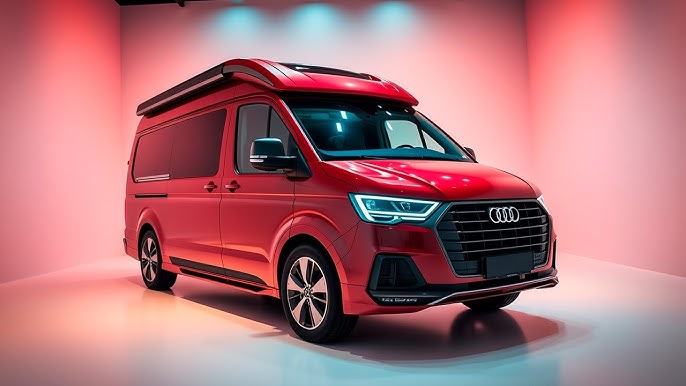
An entirely hypothetical problem caused by entirely fictional vehicles that look suspiciously convincing.
Introduction
Let’s clear this up immediately: Audi does not make a motorhome. BMW does not make a motorhome. Porsche most definitely does not make a motorhome. And yet, if you’ve spent more than five minutes scrolling lately, you’d be forgiven for thinking Ingolstadt has quietly pivoted from RS models to artisanal campervans with ambient lighting.
The reason your feed is full of “Audi motorhomes” is not because the brand has lost its mind. It’s because highly convincing concept images travel faster than facts. And because the idea of German luxury brands building campervans is just believable enough to slip past your scepticism before you realise something is very wrong.
This is not a product launch story. It’s a case study in how fantasy, branding, and algorithmic enthusiasm have combined to create a rolling hallucination on wheels.
Brand DNA vs the Campervan Fantasy
Audi’s brand DNA is ruthlessly clear. Precision. Restraint. Controlled aggression. Cars engineered to make accountants feel like racing drivers on the A38. Nothing about that screams “parked sideways on a cliff edge with a fold-out espresso machine.”
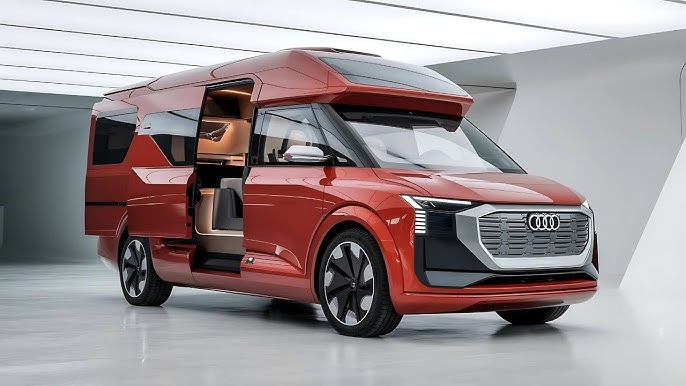
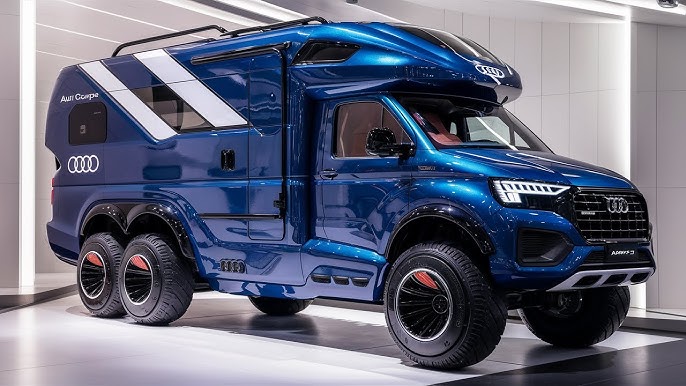
The Audi motorhome concept images floating around present something else entirely: a design language stretched until it snaps. Vast slab-sided camper bodies, enormous glass areas, lounge seating, and sometimes — inexplicably — quattro badges slapped on something with the aerodynamic integrity of a garden shed.
This is where the fantasy collapses. Audi’s design philosophy is about proportion and tension. Campervans are about volume and compromise. Trying to merge the two is like asking a Bauhaus architect to design a bouncy castle.
The images look plausible because they borrow Audi’s surface details: LED light signatures, minimalist grilles, muted colour palettes. But remove the badge, and you’re left with a premium-filtered van pretending to be something it fundamentally is not.
Design Implications Nobody Talks About
Look closely at these so-called Audi motorhomes and the problems become obvious.
The proportions are wrong. The wheels are too small. The overhangs are absurd. The glass-to-body ratio would turn the interior into a greenhouse by mid-morning. And the ride height suggests off-road capability that the underlying physics would never allow.
Real campervan design is brutally practical. Weight distribution matters. Centre of gravity matters. Crash structures matter. The images ignore all of this in favour of “wouldn’t it be cool if…”
It wouldn’t. It would be terrifying.
Audi engineers spend years shaving millimetres and grams to preserve handling characteristics. A motorhome requires adding mass everywhere Audi normally removes it. Water tanks. Furniture. Batteries. Beds. Kitchens. Toilets. The result would be a vehicle that violates every internal design principle Audi holds sacred.
And no amount of dynamic lighting can fix that.
Interior Philosophy: Minimalism Meets Microwave
The interior renders are where the fantasy becomes most ambitious — and most dishonest.
They show serene, minimalist spaces with floating furniture, indirect lighting, and spotless surfaces. No clutter. No cables. No evidence that anyone has ever actually camped inside one.
Real campervan interiors are a war between aesthetics and reality. You need storage. You need ventilation. You need things bolted down so they don’t kill you during emergency braking. You need materials that survive moisture, heat, cold, and abuse.
Audi interiors are designed for controlled environments. Even their toughest materials assume a climate-controlled cabin, not condensation, mud, wet dogs, and boiling kettles.
An Audi motorhome interior that looked like the renders would survive approximately one weekend before becoming an expensive lesson in why yachts use marine-grade everything.
Market Positioning That Makes No Sense
Let’s assume, briefly, that Audi ignored all of this and built a motorhome anyway.
Who is it for?
It’s too expensive for traditional campervan buyers, who already complain about the price of a Volkswagen California. It’s too compromised for luxury buyers, who could have an actual luxury SUV and stay in an actual hotel. And it’s too large and impractical for Audi’s existing customer base, who like their cars fast, discreet, and easy to park.
Audi’s market positioning relies on scale and shared platforms. Motorhomes are niche products with low volume and high development cost. They do not align with modular architectures or global efficiency strategies.
This is not a gap in the market. It’s a void.
Brand Risk Nobody at Audi Would Accept
Luxury brands are conservative for a reason. Brand dilution is expensive.
Audi has spent decades positioning itself between BMW’s aggression and Mercedes’ indulgence. Introducing a motorhome — even a premium one — would drag the brand into a lifestyle segment it cannot control.
Suddenly Audi isn’t about driving. It’s about camping culture. Influencers. Fold-out awnings. Customer complaints about damp seals. That is not a reputational risk any German board would tolerate.
Volkswagen can sell campervans because Volkswagen is a mass-market brand with heritage in vans. Audi does not have that permission. Borrowing it would not be bold. It would be reckless.
Why These Images Spread So Easily
The reason the AI campervan scam works is simple: the concept feels emotionally correct, even if it’s technically wrong.
People like the idea of brands they trust entering lifestyles they aspire to. An Audi motorhome promises precision engineering and taste applied to freedom and escape. It flatters the viewer’s self-image.
The algorithms don’t care whether it’s real. They care whether you stop scrolling.
And because these images rarely make explicit claims, they skate past outright falsehood. They imply. They suggest. They let the badge do the lying.
Potential Specifications
To make an Audi motorhome even remotely viable, the following would be required — not predicted, required.
- Powertrain: A plug-in hybrid system derived from Audi’s existing longitudinal platforms, as full EV range would be inadequate for sustained loads and remote travel
- Power output: At least 400 hp combined, not for speed but for safe overtaking and load management
- Drivetrain: Permanent all-wheel drive, more for stability under mass than off-road pretence
- Platform: A heavily reinforced commercial van chassis, likely sourced externally, not an Audi-developed architecture
- Performance estimates: 0–62 mph in “eventually,” with braking performance as the true engineering challenge
- Estimated price range: £130,000–£180,000 before options, immediately eliminating most potential buyers
At this point, it would no longer be an Audi in any meaningful sense.
Reality Check
Could this be built?
Yes, with significant outsourcing and compromise.
Would it make financial sense?
No. Development costs and low volumes would be unjustifiable.
Is there a realistic customer for it?
Not enough to matter.
Final Verdict
The Audi motorhome exists because it looks good in a square image and feels good as an idea. That is not how cars are built.
This isn’t a glimpse of the future.
It’s branding cosplay, fed by algorithms and wishful thinking.



 UNBUILT GARAGE
Leave a comment