
This is a speculative critique, not a product announcement, examining how one company’s philosophy was misunderstood, diluted, and mass-produced by everyone else.
Introduction
Let’s get this out of the way immediately: Tesla didn’t ruin cars. There is no secret meeting where Elon Musk stood on a table and declared war on buttons, engines, or joy. And yet, if you spend five minutes in a modern car showroom, it’s easy to think that something has gone badly wrong.
What people are reacting to online — in comment sections, renders, and furious forum posts — isn’t Tesla itself, but the industry’s increasingly desperate attempt to copy Tesla without understanding why it worked. The result is not innovation. It’s imitation without context.
And that is how you end up with a £60,000 family SUV that feels like a malfunctioning iPad glued to a rental car.
Brand DNA vs the Tesla Approach
Tesla’s original appeal was not minimalism for its own sake. It was clarity.
Early Teslas didn’t remove buttons because buttons were evil. They removed them because Tesla had no legacy. No heritage interior layouts. No decades of customers expecting the wiper stalk to feel exactly like it did in 1998. They started with a blank sheet and asked a simple question: what does an electric car actually need?
The answer, at the time, was range, simplicity, and a sense that this thing came from the future rather than a focus group.
Legacy manufacturers, however, looked at the surface-level results — the big screen, the lack of switches, the clean dashboard — and copied those. They did not copy the underlying logic. They did not copy the software competence. And crucially, they did not copy the confidence to commit fully.
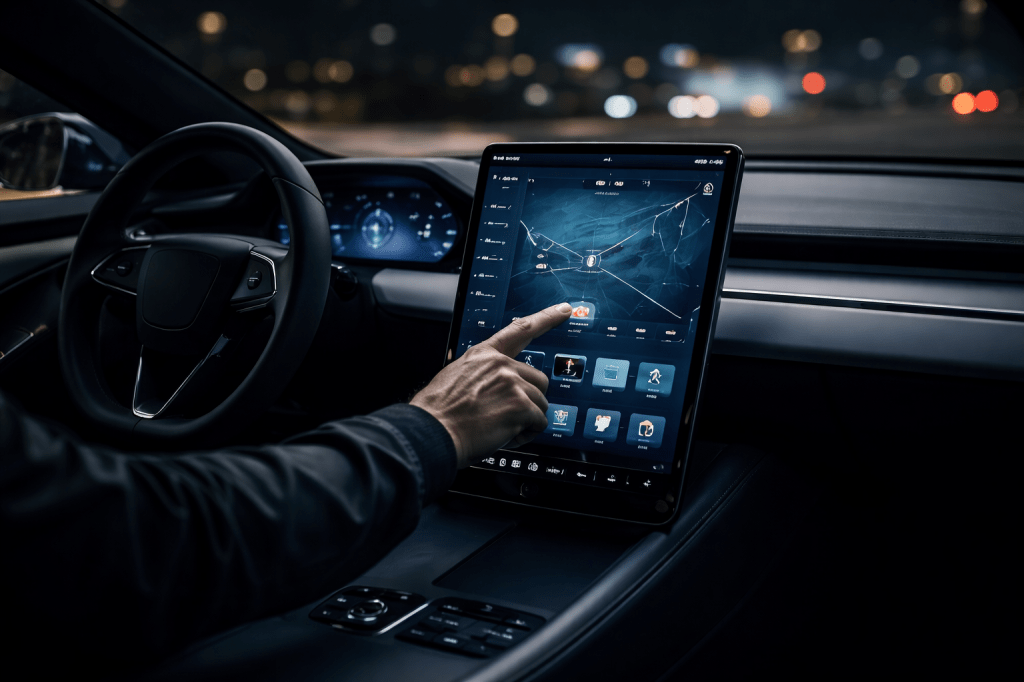
So instead of coherent design, we got compromise. A touchscreen that controls everything, paired with menus that feel like they were written by someone who last used a smartphone in 2012.
Tesla didn’t do that. Everyone else did.
The Design Fallout Nobody Wanted
Tesla interiors are divisive, but they are consistent. You may not like them, but they make sense within their own universe.
What followed, however, was chaos.
Manufacturers began stripping interiors under the banner of “modernity,” while quietly cutting costs. Physical controls disappeared not because software was better, but because plastic was expensive. Screens grew not because it improved usability, but because marketing departments love a number they can measure in inches.
The result is a generation of cars where the interior design feels unfinished. Vast, empty dashboards. Glossy black surfaces that show fingerprints if you look at them too hard. Ambient lighting used as a distraction technique.
This is not Tesla’s fault. Tesla never claimed this was the only way to build a car. Everyone else simply panicked and followed.
Interior Philosophy: Minimalism vs Absence
There is a critical difference between minimalism and absence.
Minimalism removes clutter while preserving function. Absence removes function and hopes you won’t notice.
Tesla’s interiors, for better or worse, were designed around the assumption that software would improve continuously. Menus would evolve. Features would be refined. Controls would adapt over time.
Most legacy manufacturers do not work like this. Their software cycles are slower, fragmented, and often outsourced. So when they remove physical controls, they are not replacing them with something better. They are replacing them with something cheaper and harder to use.
Heated seats buried three menus deep are not futuristic. They are irritating.
Again, Tesla didn’t mandate this. Others chose it.
Market Positioning and the Copycat Spiral
Tesla occupies a strange space. It is simultaneously a tech brand, a car brand, and a cultural object. That allowed it to get away with things traditional brands could not.
When Tesla launched a sparse interior, customers saw boldness. When a century-old manufacturer does the same thing, customers see penny-pinching.
The industry response, however, was not to reinterpret Tesla’s ideas through their own brand DNA. It was to abandon that DNA entirely.
BMWs began to feel less like BMWs. Mercedes interiors became screens first, cars second. Even brands known for tactile quality started talking about “digital experiences” instead of how the steering wheel feels.
Tesla didn’t force this shift. The market did. And the market misunderstood what it was buying.
Tesla Didn’t Ruin Cars — Everyone Else Copying Tesla Did
This is where the central misunderstanding lives.
Tesla succeeded because it broke rules it never needed to obey. It had no heritage customers to alienate. No engine note to preserve. No dealer network to appease. It was free to be weird.
When everyone else copied Tesla, they broke rules they absolutely did need to obey.
A Volkswagen should feel intuitive. A Porsche should feel mechanical. A Volvo should feel reassuring. When those brands chase Tesla’s aesthetic instead of translating its philosophy, they lose what made them desirable in the first place.
Tesla didn’t erase character from the industry. The industry erased its own character out of fear of being left behind.
The Software Problem Nobody Likes Talking About
Here’s the uncomfortable bit.
Tesla can get away with screen-heavy interiors because its software is, generally, competent. Not perfect, but responsive, cohesive, and regularly updated.
Most manufacturers are not software companies. They are hardware companies pretending to be software companies. And it shows.
Laggy interfaces, inconsistent menu logic, and features that break after updates are not acceptable replacements for physical controls. Yet that is what many buyers are being sold.
The tragedy is that this was avoidable. Tesla showed what was possible. Others copied what was visible.
Potential Specifications
To understand how this philosophy could have been applied correctly by legacy manufacturers, it helps to ground the discussion in what would actually be required to make a Tesla-style approach viable.
Not as a prediction — but as a requirement.
- Powertrain
Fully electric, not hybrid. Half measures undermine the packaging and software integration that make minimal interiors viable. - Platform
Dedicated EV architecture with flat floor and centralized computing. Retrofitted ICE platforms cannot support clean layouts without compromise. - User Interface Hardware
One primary central display, supported by a secondary driver display or head-up display. Redundancy matters. - Software Stack
In-house OS with over-the-air update capability. Outsourced, supplier-based systems are fundamentally incompatible with Tesla-style interiors. - Physical Controls
Retained for safety-critical and frequently used functions: indicators, wipers, climate overrides. Minimalism does not mean deletion. - Price Positioning
Mid to upper market. Cost-cutting disguised as futurism only works once.
Without these foundations, copying Tesla is not innovation. It is cosplay.
Reality Check
Could this be built?
Yes. Tesla has already demonstrated that the core concept works when executed with the right technical foundation.
Would it make financial sense?
Only for manufacturers willing to invest heavily in software, UI design, and long-term platform thinking. Short-term savings destroy long-term value.
Is there a realistic customer for it?
Yes — but only if the execution respects the brand’s identity rather than abandoning it. Customers want progress, not confusion.
Final Verdict
Tesla didn’t ruin cars. It exposed how fragile the industry’s confidence had become.
The real damage was done by manufacturers who mistook aesthetics for strategy, screens for progress, and minimalism for cost reduction. Tesla built a new language. Everyone else copied the accent and forgot the grammar.
The problem isn’t that cars became more like Teslas.
It’s that they stopped being themselves.

 UNBUILT GARAGE
Leave a comment