Before every dashboard became the same black slab with a tablet glued to it, some carmakers were allowed to behave like lunatics.
Modern car interiors are very good at being expensive.
They are also, with a few honourable exceptions, very good at being the same.
You get the same giant touchscreen. The same gloss-black paneling. The same strip of ambient lighting trying to convince you this is somehow futuristic. The same flat, sterilised dashboard architecture that has all the personality of a business lounge at an airport nobody likes.
It is all perfectly competent.
And then you look back at the cars in this list and realise there was once a time when designers were allowed to do something far more interesting: take a genuine swing.
Not with a quirky button here or an odd trim choice there, but with entire cabins. Dashboard structures. Instrument layouts. Control systems. Driver environments. The sort of interiors that make you stop mid-scroll, stare at the photo, and ask the only sensible question:
They actually sold this?
That is the standard here.
These are not concept cars.
These are not one-off showpieces.
These are not design-studio fantasies that never had to survive contact with the public.
These were real production cars.
Real customers could buy them.
And somehow, every one of them made it through.
5. Subaru XT (1985–1991)
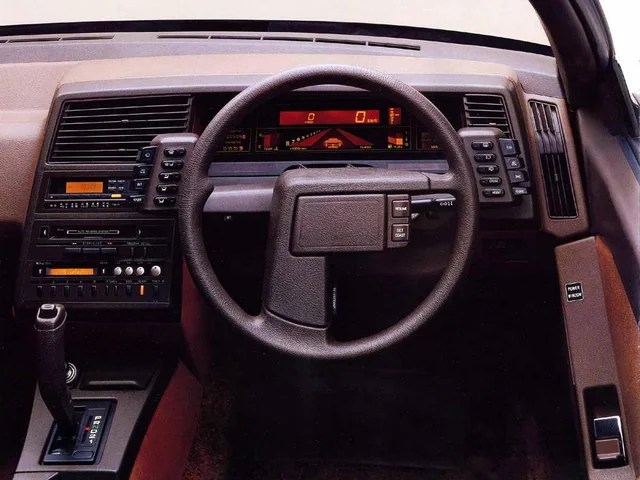
The Subaru XT is what happens when a perfectly sensible Japanese company suddenly decides conventional switchgear is an insult to progress.
From the outside, it already looks slightly suspicious — all sharp edges, low drag obsession, and unmistakable 1980s futurism. But the real surprise is inside, where Subaru decided that the usual arrangement of stalks, buttons and instruments was clearly too ordinary for a coupe that looked like it had escaped from a forgotten sci-fi anime.
So instead, the XT’s cabin revolves around a deeply unconventional steering wheel and control-pod layout, with many major functions clustered around the wheel itself in a way that still feels faintly absurd now. It is not just “a bit different.” It changes the entire logic of how the driver interacts with the car.
That matters.
Because there is a difference between a strange interior and a genuinely crazy one.
A strange interior has odd styling.
A crazy one makes you question the operating system.
The XT is not here because it is luxurious.
It is not here because it is pretty.
It is here because Subaru briefly behaved like a company trying to redesign how humans should drive.
And that is more than enough.
4. Vector W8 (1989–1993)
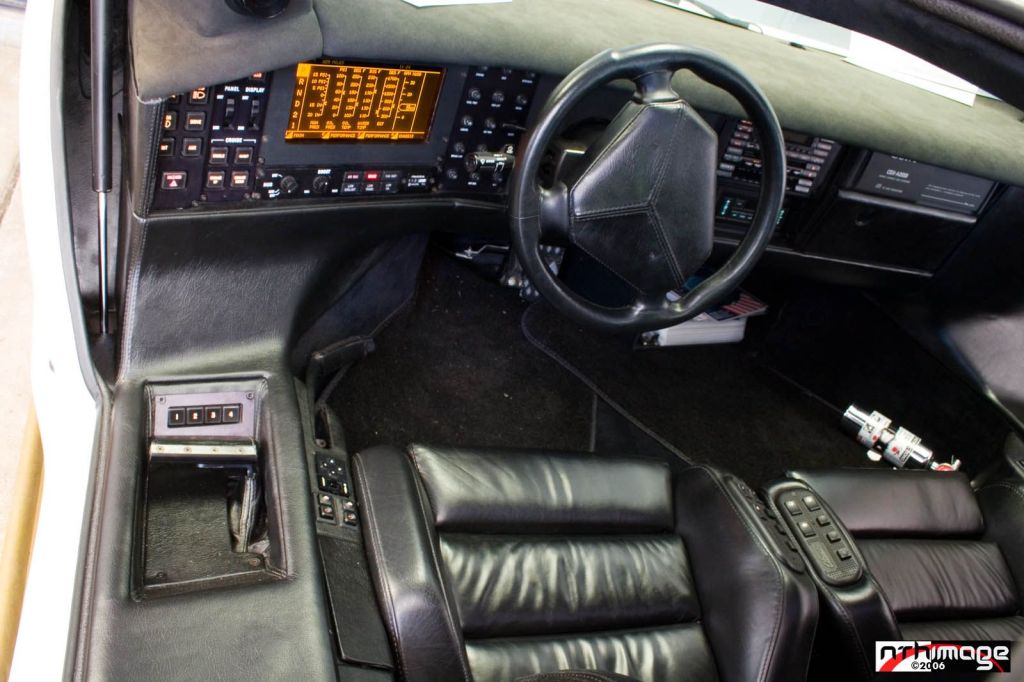
If the Subaru XT feels like a bold experiment, the Vector W8 feels like an American aerospace contractor accidentally got approved to build a supercar.
This was never going to be a normal car. Even the exterior looks as though it should be parked in a hangar rather than a garage. So it is entirely fitting that the cabin doesn’t feel like the inside of a road car either. It feels like the sort of place where somebody should be reading checklists out loud.
The W8’s interior is all fighter-jet theatre, deep instrumentation, aviation-style seriousness, and an overall sense that you are not simply driving somewhere — you are being entrusted with a machine that may or may not require clearance.
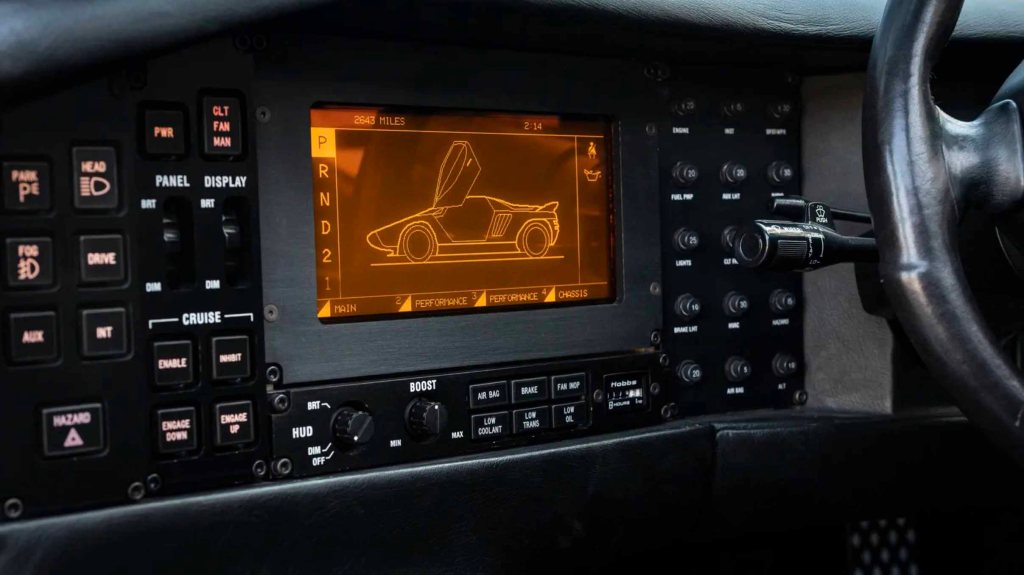
And that is exactly why it works.
A lot of supercars try to look dramatic inside.
The Vector W8 doesn’t try.
It looks like the dashboard was designed by people who thought Ferraris were insufficiently militarised.
This is not “quirky.”
It is not “eccentric.”
It is the sort of interior that makes you wonder whether the owner’s manual begins with a safety briefing.
Which is why it earns its place.
3. Lancia Trevi (1980–1984)
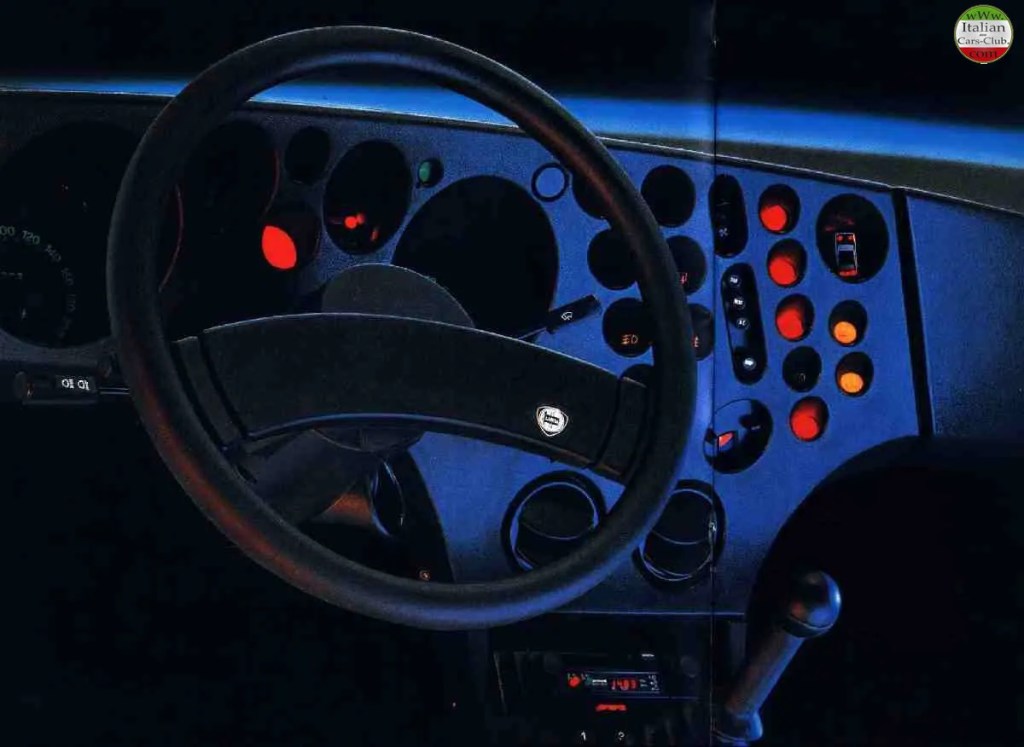
The Lancia Trevi proves a wonderful and slightly alarming point: Italian designers do not need an exotic supercar to produce absolute madness.
Because this is, on paper, just a compact executive saloon.
And then you look at the dashboard.
The Trevi’s interior became famous — and not accidentally — for what everyone quickly started calling the “Swiss cheese” dashboard. Designed with input from Mario Bellini, the instrument panel is dominated by a series of dramatic circular recesses and clustered openings that make it look as though somebody took a conventional dashboard, attacked it with an industrial hole saw, and then somehow convinced management that this was not only acceptable, but sophisticated.
Incredibly, it sort of is.
That is what makes the Trevi such a brilliant inclusion here.
It is not the glamorous kind of crazy.
It is not space-age American theatre.
It is not digital luxury overreach.
It is something rarer than all of those: a production dashboard that is visibly deranged on first contact.
You do not need context.
You do not need a history lesson.
You just need one photograph.
The Trevi is what happens when Lancia stops asking whether something is sensible and starts asking whether it is memorable.
And on that basis, it is one of the most successful interiors ever made.
2. Aston Martin Lagonda (Series 2 / 3 / 4)
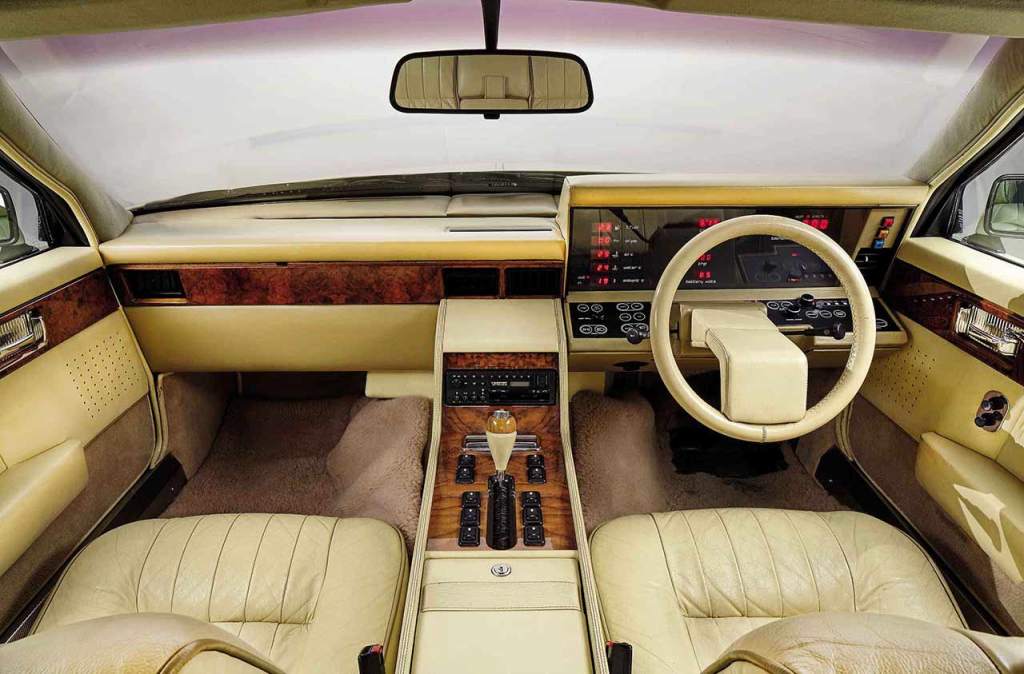
The Aston Martin Lagonda is what happens when a luxury brand decides the future should arrive immediately, even if the electronics are still emotionally unprepared.
Most luxury cars of the late 1970s and 1980s took a fairly predictable approach to prestige. They offered leather, wood, polished restraint, and the sort of atmosphere that suggested one should lower one’s voice in the back seat.
The Lagonda took one look at that and decided to become a spaceship.
This was not a traditional luxury interior with a few futuristic flourishes. It was a full-scale rejection of conventional automotive decorum. The Lagonda’s cabin embraced digital instrumentation, touch-sensitive controls, and a dashboard philosophy that felt wildly more ambitious than the era had any right to support. Where rivals were polishing walnut, Aston Martin was attempting to drag the showroom into the next century by force.
That is why it remains one of the maddest production interiors ever built.
Not because it was merely odd-looking.
Because it represented a manufacturer making a completely serious, deeply expensive bet on a future that barely existed yet.
And yes, some of the technology was temperamental.
That is almost part of the charm.
Because the Lagonda does not feel like a car that carefully evolved toward modernity. It feels like a car that skipped the intermediate steps entirely and hoped the laws of electronics would catch up later.
That sort of confidence is either admirable or deranged.
In this case, it is both.
1. Oldsmobile Toronado (1966)
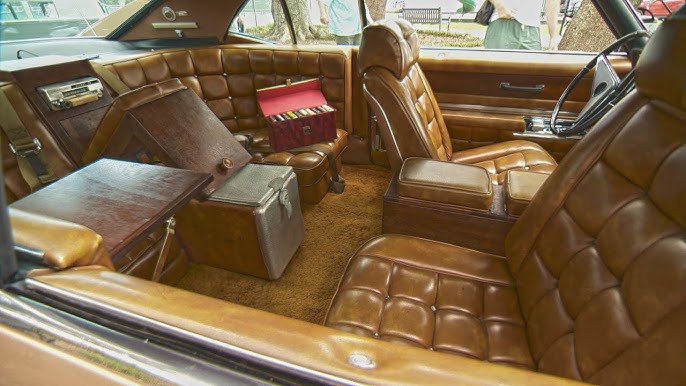
If the Lagonda feels like a futuristic luxury experiment, the 1966 Oldsmobile Toronado feels like somebody in Detroit saw the space race, became utterly intoxicated by the idea of tomorrow, and then decided a normal dashboard simply was not going to be enough.
This is the winner because it does something the others don’t quite manage.
It is not just weird.
It is not just ambitious.
It is not just memorable.
It is beautifully insane.
The Toronado’s cabin is one of the very few production interiors that still looks genuinely shocking in a modern photo. The dashboard is wide, sculptural and deeply theatrical, with a dramatic wraparound shape that makes many later American luxury coupes look oddly timid. It has that glorious mid-century “future” energy — part aircraft, part hi-fi equipment, part living-room furniture designed by people who believed the year 2000 would be full of chrome and optimism.
And then there’s the back.
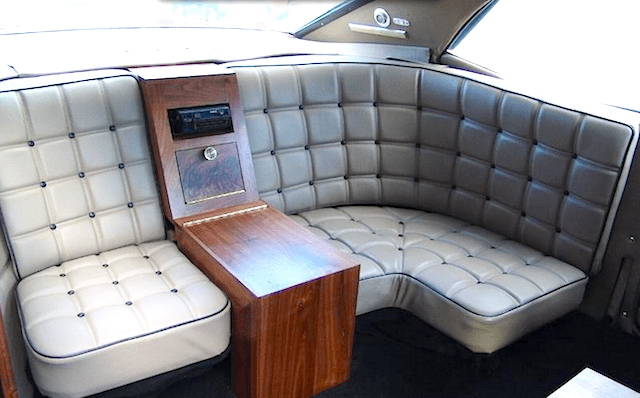
Because while the front of the Toronado looks like a concept car that somehow slipped into a dealership, the rear cabin has the atmosphere of a very stylish old pub lounge. It is over-upholstered, faintly decadent, and weirdly inviting in a way that makes it feel less like the back seat of a coupe and more like somewhere a man in a sports coat should be quietly nursing a whisky.
That contrast is what makes it brilliant.
The front says:
“Tomorrow has arrived.”
The back says:
“Yes, but let’s make it comfortable enough for a drink.”
That is not merely eccentricity.
That is world-building.
Unlike some of the other cars here, the Toronado is not carried by novelty alone.
It is not here because it had unusual technology.
It is not here because it was quirky.
It is not here because it was simply of its time.
It is here because the entire cabin feels like a complete design event.
You do not need to explain the Toronado’s inclusion.
You just show the photographs.
And if a production car interior can still do that after all these years, it deserves the top spot.
Final Verdict
Modern interiors are cleaner. Better built. Easier to understand. Less likely to require a briefing.
They are also, in most cases, far less brave.
The five cars here come from an era when designers were still allowed to experiment with dashboard architecture, instrument logic, and driver environments in ways that would now be strangled by committees, cost controls, safety protocols, and six separate focus groups asking whether customers might prefer another black panel with a screen on it.
Some of these interiors were beautiful.
Some were bizarre.
Some were probably a terrible idea.
All of them were unforgettable.
And that is what matters.
Because if a car interior is going to be strange, it should at least be strange enough that people are still staring at it decades later and wondering how on earth it ever made production.
These five absolutely are.
 UNBUILT GARAGE
Leave a comment